
Mã sản phẩm: RG-AP840-L
Highlight Features
5G optical port and 5G electrical port for flexible networking
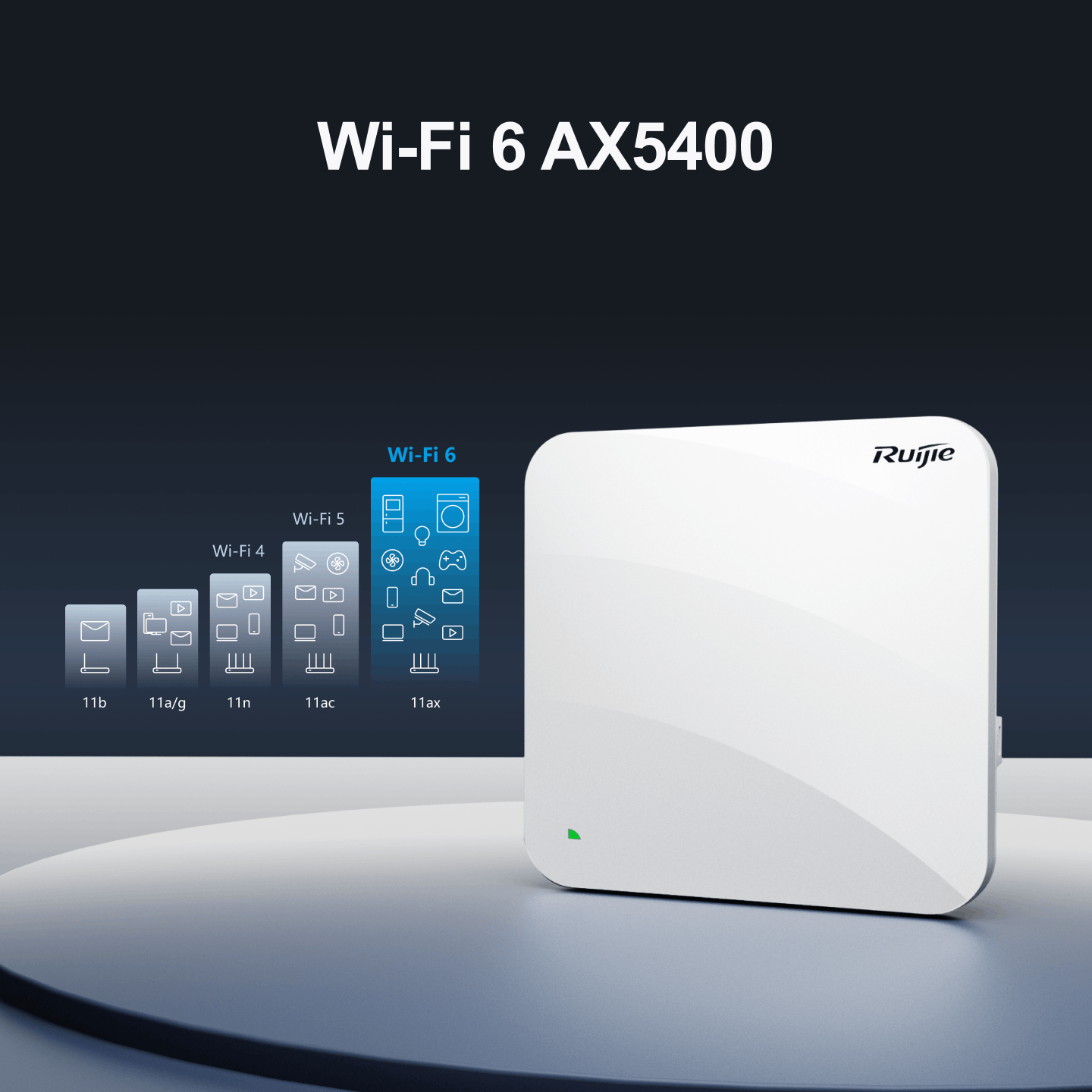
Upgraded to Wi-Fi 6, a combined data rate of up to 5.378 Gbps
160 MHz and 6 spatial streams for smoother wireless experiences
Ruijie cloud management, intelligent optimiza
| Dimensions and Weight | RG-AP840-L |
| Unit dimensions(W x D x H) | 230 mm x 230 mm x 51 mm (9.06 in. x 9.06 in. x 2.01 in.) |
| Shipping dimensions(W x D x H) | 535 mm x 406 mm x 269 mm (21.06 in. x 15.98 in. x 10.59 in.) |
| Unit weight | Main unit: 1.0 kg (2.20 lbs)
Mounting bracket: 0.1 kg (0.22 lbs) |
| Shipping weight | 13.67 kg (30.14 lbs) |
| Mounting | Wall/Ceiling-mount (a mounting bracket is delivered with the main unit) |
| Lock option | Kensington lock and securing latch |
| Wi-Fi Radio | RG-AP840-L |
| Radio design | Dual-radio and up to six spatial streams:
● Radio 1: 2.4 GHz, two spatial streams, 2×2 MU-MIMO ● Radio 2: 5 GHz, four spatial streams, 4×4 MU-MIMO |
| Operating frequencies | 802.11b/g/n/ax:
● 2.400 GHz to 2.4835 GHz, ISM 802.11a/n/ac/ax: ● 5.150 GHz to 5.250 GHz, U-NII-1 ● 5.250 GHz to 5.350 GHz, U-NII-2A ● 5.470 GHz to 5.725 GHz, U-NII-2C ● 5.725 GHz to 5.850 GHz, U-NII-3/ISM Note: Available frequency bands may vary with countries or regions. To use the above-mentioned frequency bands, ensure that they are supported in your country or region. For details, see WLAN Country or Region Codes and Channel Compliance. |
| Data rates | Combined peak data rate: 5.378 Gbps
5 GHz radio: ● Four spatial stream Single User (SU) MIMO for up to 4.804 Gbps wireless data rate to individual 4SS HE160 802.11ax client devices (maximum) ● Two spatial stream Single User (SU) MIMO for up to 1.201 Gbps wireless data rate to individual 2SS HE80 802.11ax client devices (typical) ● Four spatial stream Multi User (MU) MIMO for up to 4.804 Gbps wireless data rate to up to four 1SS or two 2SS HE160 802.11ax DL-MU-MIMO capable client devices simultaneously (maximum) ● Four spatial stream Multi User (MU) MIMO for up to 2.402 Gbps wireless data rate to up to four 1SS or two 2SS HE80 802.11ax DL-MU-MIMO capable client devices simultaneously (typical) 2.4 GHz radio: ● Two spatial stream Single User (SU) MIMO for up to 574 Mbps wireless data rate to 2SS HE40 802.11ax client devices (maximum) ● Two spatial stream Single User (SU) MIMO for up to 287 Mbps wireless data rate to 2SS HE20 802.11ax client devices (typical) |
| Data rate set | The following 802.11-compliant data rates in Mbps are supported:
2.4 GHz radio ● 802.11b: 1, 2, 5.5, 11 ● 802.11g: 1, 2, 5.5, 6, 9, 11, 12, 18, 24, 36, 48, 54 ● 802.11n: 6.5 to 300 (MCS0 to MCS15, HT20 to HT40) ● 802.11ax: 8.6 to 574 (MCS0 to MCS11, NSS = 1 to 2, HE20 to HE40) 5 GHz radio ● 802.11a: 6, 9, 12, 18, 24, 36, 48, 54 ● 802.11n: 6.5 to 600 (MCS0 to MCS31, HT20 to HT40) ● 802.11ac: 6.5 to 3,467 (MCS0 to MCS9, NSS = 1 to 4, VHT20 to VHT160) ● 802.11ax: 8.6 to 4,804 (MCS0 to MCS11, NSS = 1 to 4, HE20 to HE160) |
| Packet aggregation | 802.11n/ac/ax: A-MPDU and A-MSDU |
| Antenna type | Built-in omnidirectional antennas (two 2.4 GHz antennas and four 5 GHz antennas) |
| Antenna gain | 2.4 GHz: 5 dBi 5 GHz: 6 dBi |
| Maximum transmit power | 2.4 GHz radio: 27 dBm (24 dBm per chain)
5 GHz radio: 30 dBm (24 dBm per chain) Note: The transmit power is limited by local regulatory requirements. For details, see WLAN Country or Region Codes and Channel Compliance.
Thailand 2.400 GHz to 2.4835 GHz, EIRP ≤ 20 dBm 5.150 GHz to 5.350 GHz, EIRP ≤ 23 dBm 5.470 GHz to 5.725 GHz, EIRP ≤ 30 dBm 5.725 GHz to 5.825 GHz, EIRP ≤ 30 dBm |
| Power increment | Configurable in increments of 1 dBm |
| Radio technologies | 802.11b: Direct-Sequence Spread-Spectrum (DSSS)
802.11a/g/n/ac: Orthogonal Frequency-Division Multiplexing (OFDM) 802.11ax: OFDMA with up to 16 resource units (for an 80 MHz channel) |
| Modulation types | 802.11b: BPSK, QPSK, and CCK
802.11a/g/n: BPSK, QPSK, 16-QAM, and 64-QAM 802.11ac: BPSK, QPSK, 16-QAM, 64-QAM, and 256-QAM 802.11ax: BPSK, QPSK, 16-QAM, 64-QAM, 256-QAM, and 1024-QAM |
The following table lists the radio frequency performance of Wi-Fi including different frequency bands, protocols, and date rates. It is country-specific, and Ruijie Networks reserves the right of interpretation.
| Wi-Fi Radio Frequency Performance | RG-AP840-L | ||
| Frequency Band and Protocol | Data Rate | MaximumTransmit Power per Transmit Chain | MaximumReceive Sensitivity per Receive Chain |
| 2.4 GHz, 802.11b | 1 Mbps | 24 dBm | –96 dBm |
| 2 Mbps | 24 dBm | –95 dBm | |
| 5.5 Mbps | 23 dBm | –93 dBm | |
| 11 Mbps | 22 dBm | –89 dBm | |
| 2.4 GHz, 802.11g | 6 Mbps | 24 dBm | –91 dBm |
| 24 Mbps | 23 dBm | –85 dBm | |
| 36 Mbps | 23 dBm | –80 dBm | |
| 54 Mbps | 21 dBm | –74 dBm | |
| 2.4 GHz, 802.11n (HT20) | MCS0 | 24 dBm | –90 dBm |
| MCS7 | 20 dBm | –70 dBm | |
| 2.4 GHz, 802.11n (HT40) | MCS0 | 24 dBm | –90 dBm |
| MCS7 | 20 dBm | –70 dBm | |
| 2.4 GHz, 802.11ax (HE20) | MCS0 | 24 dBm | –90 dBm |
| MCS11 | 16 dBm | –62 dBm | |
| 2.4 GHz, 802.11ax (HE40) | MCS0 | 24 dBm | –88 dBm |
| MCS11 | 16 dBm | –60 dBm | |
| 5 GHz, 802.11a | 6 Mbps | 24 dBm | –91 dBm |
| 24 Mbps | 23 dBm | –85 dBm | |
| 36 Mbps | 23 dBm | –80 dBm | |
| 54 Mbps | 21 dBm | –74 dBm | |
| 5 GHz, 802.11n (HT20) | MCS0 | 24 dBm | –90 dBm |
| MCS7 | 20 dBm | –68 dBm | |
| 5 GHz, 802.11n (HT40) | MCS0 | 24 dBm | –88 dBm |
| MCS7 | 20 dBm | –68 dBm | |
| 5 GHz, 802.11ac (VHT20) | MCS0 | 24 dBm | –90 dBm |
| MCS9 | 18 dBm | –68 dBm | |
| 5 GHz, 802.11ac (VHT40) | MCS0 | 24 dBm | –88 dBm |
| MCS9 | 18 dBm | –63 dBm | |
| 5 GHz, 802.11ac (VHT80) | MCS0 | 24 dBm | –85 dBm |
| MCS9 | 18 dBm | –60 dBm | |
| 5 GHz, 802.11ax (HE20) | MCS0 | 24 dBm | –90 dBm |
| MCS11 | 16 dBm | –60 dBm | |
| 5 GHz, 802.11ax (HE40) | MCS0 | 24 dBm | –86 dBm |
| MCS11 | 16 dBm | –56 dBm | |
| 5 GHz, 802.11ax (HE80) | MCS0 | 24 dBm | –83 dBm |
| MCS11 | 24 dBm | –53 dBm | |
| 5 GHz, 802.11ax (HE160) | MCS0 | 16 dBm | –81 dBm |
| MCS11 | 16 dBm | –51 dBm | |
| Bluetooth Radio | RG-AP840-L |
| Bluetooth | Bluetooth 5.1 |
| Antenna type | Integrated vertically polarized omnidirectional antenna |
| Maximum antenna gain | 3.5 dBi, with a downtilt angle of roughly 30 degrees |
| Maximum transmit power | 10 dBm (Class 1) |
| Receive sensitivity | –98 dBm |
| Ports Specifications | RG-AP840-L |
| Fixed service port | 1 x 100/1000/2.5G/5GBASE-T port
● Auto MDI/MDIX crossover ● NBASE-T/IEEE802.3bz-compliant 5 Gbps ● PoE-PD: 54 V DC (nominal value) 802.3af/at/bt (Class 3 or higher) ● 802.3az EEE 1 x 5GE SFP/RJ45 combo port, compatibility with 1GE and 2.5GE modules 1 x 10/100/1000BASE-T port ● Supplying 48 V/12.95 W power to an IoT unit ● Auto MDI/MDIX crossover ● 802.3az EEE |
| Fixed management port | 1 x RJ45 console port (serial console port) |
| USB | USB 3.0 (Type-A connector) |
| Status LED | 1 x multi-color system status LED |
| Button | 1 x Reset button
● Press the button for shorter than 2 seconds. Then the device restarts. ● Press the button for longer than 5 seconds. Then the device restores to factory settings. |
| Power Supply and Consumption | RG-AP840-L |
| Input power supply | The AP supports the following two power supply modes:
● 54 V DC/1.1 A power input over DC connector: The DC connector accepts 2.1 mm/5.5 mm center-positive circular plug. A DC power adapter needs to be purchased independently. ● PoE input over LAN 1: The power source equipment (PSE) complies with IEEE 802.3af/at/bt standard (PoE/PoE+/PoE++). Note: ● If both DC power and PoE are available, DC power is preferred. ● When powered by 802.3bt (PoE++), the AP operates with the optimal performance. ● When powered by 802.3at (PoE+), the AP starts up normally. LAN 2 and USB port cannot supply power to external devices. ● When powered by 802.3af (PoE), the AP starts up normally. Both 2.4 GHz and 5 GHz radio cards can work only in one spatial stream mode. LAN 2 and USB port cannot supply power to external devices. |
| PoE port | When powered by 802.3bt (PoE++), the LAN 2 port can source 48 V/12.95 W power to a unit. |
| USB port | When powered by 802.3bt (PoE++), the USB port can source 1 A/5 W power to an attached device. |
| Overall power consumption | Maximum power consumption: 40 W
● DC powered: 40 W ● PoE powered (802.3af): 12.95 W ● PoE+ powered (802.3at): 22 W ● PoE++ powered (802.3bt): 40 W ● Idle mode: 10.3 W |
| Environment and Reliability | RG-AP840-L |
| Temperature | Operating temperature: –10°C to +50°C (14°F to 122°F)
Storage temperature: –40°C to 70°C (–40°F to +158°F) Note: At an altitude in the range of 3,000–5,000 m (9,842.52–16,404.20 ft.), every time the altitude increases by 220 m (722 ft), the maximum temperature decreases by 1°C (1.8°F). |
| Humidity | Operating humidity: 5% RH to 95% RH (non-condensing)
Storage humidity: 5% RH to 95% RH (non-condensing) |
| Mean Time Between Failure (MTBF) | 394,941 hours (45 years) at the operating temperature of 25°C (77°F) |
| Regulatory Compliance | RG-AP840-L |
| Security regulations | IEC 62368-1
EN 62368-1 |
| EMC regulations | EN 55032
EN 55035 EN IEC 61000-3-2 EN 61000-3-3 EN 301 489-1 EN 301 489-3 EN 301 489-17 |
| Radio frequency regulations | EN 300 328
EN 301 893 EN 300 440 EN IEC 62311 FCC Part 15 |
*For more country-specific regulatory information and approvals, contact your local sales agency.
| Applicable Software Version | RG-AP840-L |
| Applicable software version | RGOS11.9(6)W3B3 or higher |
| WLAN | RG-AP840-L |
| Recommended maximum number of active devices per AP | 150 |
| Maximum number of associated clients | 1024
Note The number of associated clients varies according to the environment. |
| Maximumnumber of BSSIDs | 32 (up to 16 BSSIDs per radio) |
| STA management | SSID hiding
Each SSID can be configured with the authentication mode, encryption mechanism, and VLAN attributes independently. Remote intelligent perception technology (RIPT) Intelligent client identification technology Intelligent load balancing based on the STA quantity or traffic |
| STA limiting | SSID-based STA limiting
Radio-based STA limiting |
| Bandwidth limiting | STA/SSID/AP-based rate limiting |
| Wireless roaming | Layer 2 and Layer 3 roaming |
| Security | RG-AP840-L |
| Authentication and encryption | Remote Authentication Dial-In User Service (RADIUS)
PSK, web, 802.1X, WPA, WPA2, and WPA3 authentication SMS authentication (used with the RG-WS series wireless access controller) MAB authentication (used with the RG-WS series wireless access controller) WEP (64/128 bits), WPA-Personal, WPA-Enterprise, WPA2-Personal, WPA2-Enterprise, WPA3-Personal (WPA2/WPA3 transition mode), WPA3-Enterprise (CCMP), WPA3-Enterprise (GCMP), WPA3-OWE |
| Data frame filtering | Allowlist, static blocklist, and dynamic blocklist |
| ACL | Dynamic ACL assignment |
| CPP | Supported |
| NFPP | Supported |
| Routing and Switching | RG-AP840-L |
| IP service | Static IPv4 address and DHCP-assigned IPv4 address
NAT, FTP ALG, DNS ALG |
| Multicast | Multicast-to-unicast conversion |
| IPv6 basics | IPv6 addressing, Neighbor Discovery (ND), ICMPv6, IPv6 Ping
IPv6 DHCP Client |
| IP routing | IPv4/IPv6 static routing |
| VPN | PPPoE Client
IPsec VPN |
| Management | RG-AP840-L |
| Network management | Fault inspection and alarm
Information statistics and logging SNMPv1/v2c/v3 NTP Server and NTP Client |
| Network management platform | Ruijie Cloud
Web-based management (Eweb) |
| User access management | Console, Telnet, SSH, SNMP, and TFTP-based management |
| Fat/Fit/Cloud mode switchover | When the AP works in Fit mode, it can be switched to Fat mode through an AC.
When the AP works in Fat mode, it can be switched to Fit mode through the console port or Telnet. When the AP works in Cloud mode, it can be managed through Ruijie Cloud. |
| Mã sản phẩm | RG-AP840-L |
|---|---|
